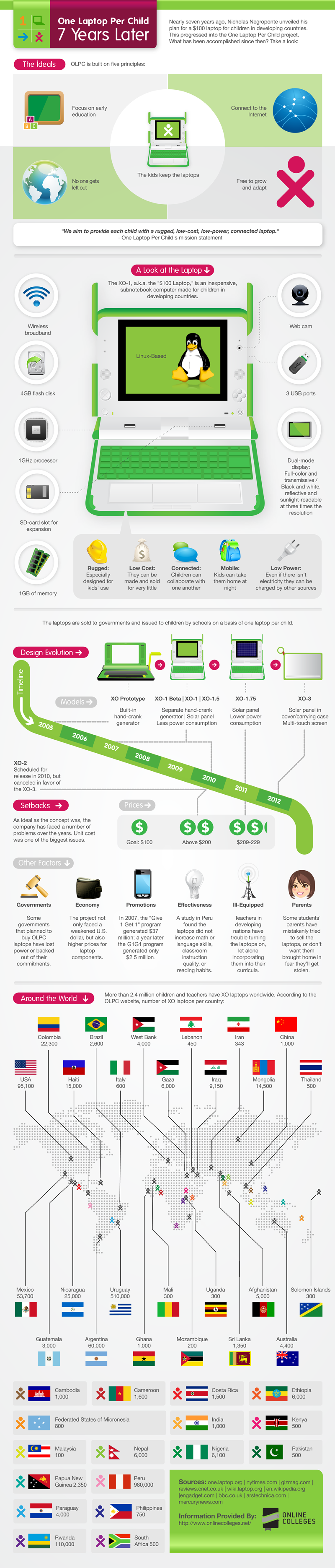
Nicholas Negroponte planned for $100 laptop for children in nearly seven years ago. They aim to provide each child with a rugged, low-cost, low power, connected laptop. OLPC is built on five principles :
1. This laptop focuses on early education, so children know how to use laptop since at the early age.
2. Connect to the internet, so children can search information form the internet.
3. The kids keep laptop.
4. No one gets left out.
5. Free to grow and adapt, so children learn by themselves and can adapt themselves to the environment.
A look at the laptop
1. wireless broadband
2. 4 GB flash disk
3. 1 GHz processor
4. SD-card slot for expansion
5. 1GB of memory
6. Web cam
7. 3USB ports
8. Dual-mode display : full-color and transmissive/ black and white, reflective and sunlight-readable at three times the resolution.
This is an inexpensive subnotebook computer made for children in developing countries
- Rugged : Designed for kid's use.
- Low cost : They can be made and sold for very little.
- Connected : Children can collaborate with one another.
- Mobile : They can take them home at night.
- Low power : Even if there isn't electricity they can be charged by other sources.
Design evolution
- XO Prototype was built in 2005. It's a built-in hand-crank generator.
- XO-1 Beta | XO-1 | XO-1.5 was built during 2007 to 2010. It's separate hand-crank generator | solar panel less power consumption.
- XO-2 was built in 2010.
- XO-1.75 was built in 2011. It's a sola panel lower power consumption.
- XO-3 was built in 2012. It's a solar panel in cover/carrying case Multi-touch screen.
Price
Unit cost was one of the biggest issues. In 2010, the price goes above $200, and in 2011 the price goes to $209-299. The goal is only $100. Factors than affect the price
- Government : Some governments that planned to buy OLPS laptops have lost power or backed out of their commitments.
- Economy : The project not only faced a weakened U.S. dollar, but also higher prices for laptop components.
- Promotions : In 2007, the "Give 1 Get 1" program generated $37 million; a year later the G1G1 program generated only $2.5 million.
- Effectiveness : A study in Peru found that laptops didn't increase math or language skills or reading habits.
- lll-Equipped : Teachers in developing nations have trouble turning the laptops on, let alone incorporating them into their curricula.
- Parents : Some students' parents have mistakenly tried to sell the laptops, or don't want them brought home in fear they'll get stolen.
*More than 2.4 million children and teachers have XO laptops worldwide. According to the OLPC website, number of XO laptops per country:
- Colombia : 22,300 - Mexico : 53,700 - Cambodia : 1,000
- Brazil : 2,600 - Nicaragua : 25,000 - Cameroon : 1,600
- West Bank : 4,000 - Uruguay : 510,000 - Costa Rica : 1,500
- Lebanon : 450 - Mali : 300 - Ethiopia : 6,000
- Iran : 343 - Uganda : 300 - Federated States of Micronesia : 800
- China : 1,000 - Afghanistan : 5,000 - India : 1,000
- USA : 95,100 - Solomon Islands : 300 - Kenya : 500
- Haiti : 15,000 - Guatemala : 3,000 - Malaysia : 100
- Italy : 600 - Argentina : 60,000 - Nepal : 6,000
- Gaza : 6,000 - Ghana : 1,000 - Nigeria : 6,100
- Iraq : 9,150 - Mozambique : 200 - Pakistan : 500
- Mongolia : 14,500 - Sri Lanka : 1,350 - Papua New Guinea : 2,350
- Thailand : 500 - Australia : 4,400 - Peru : 980,000
- Paraguay : 4,000 - Rwanda : 110,000 - South Africa : 500
-Philippines : 750
How to get started using an OLPC laptop
Major concepts
- Nicholas Negroponte unveiled his plan for a $100 laptop for children in developing countries.
- OLPC built on five principles : Focus on early education, connect to the internet, the kids keep the laptops, no one gets left out, and free to grow and adapt.
- The prices is getting higher.
- Nowadays, XO laptops use by children worldwide.
Potential Strengths/Advantages
- This is make children's life become easier.
- Children can search information from the internet.
- They can save their work in the laptops.
Potential Problems/Limitations/Disadvantages
- The price is getting higher.
- If the children can connect to the internet, they could easily find some games or some silly stuffs.
Discussion Questions
- Do every children get this laptop?
- For the children in the countries that are not developing, will they have the chance to use this laptop?
"ONE LAPTOP PER CHILD 7 YEARS LATER." Infographics King. N.p., n.d. Web. 17 Feb. 2013.

No comments:
Post a Comment